

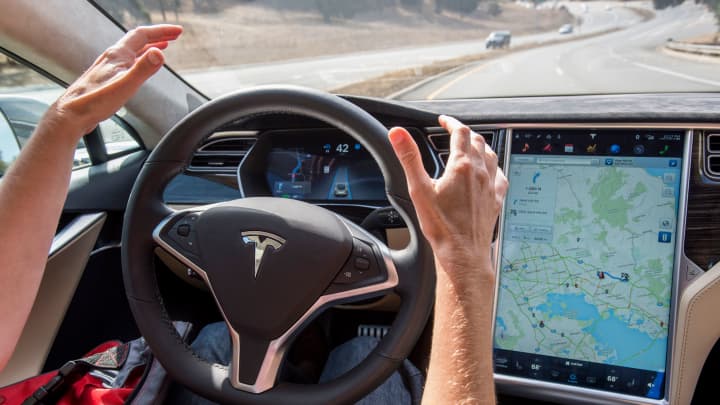
In a bold move that cements its position at the forefront of the automotive and technology industries, Tesla has unveiled its next-generation Autopilot system, marking what many experts are calling a major leap forward in autonomous driving technology. This new system, developed through years of research, real-world data collection, and advanced artificial intelligence, represents not just an upgrade of existing features but a reimagining of what self-driving vehicles can achieve in terms of safety, efficiency, and driver comfort.
Tesla’s latest Autopilot iteration builds on the foundation of its existing Full Self-Driving (FSD) platform but incorporates several pivotal innovations. Key among these is its enhanced neural network architecture, which enables the system to interpret complex driving environments with near-human perception. The company claims the new Autopilot can process visual data up to ten times faster than previous versions, increasing reaction speed and improving decision-making in dynamic road scenarios.
The improved performance is largely attributed to Tesla’s proprietary Dojo supercomputer, which trains the neural networks using billions of miles of driving data collected from Tesla vehicles around the world. This deep learning approach allows the system to adapt continuously, refining its algorithms based on real-world behavior rather than simulations alone. The result is an AI-driven vehicle that gets smarter and safer with every trip.
Another significant advancement lies in the sensor and camera suite. While earlier systems relied heavily on radar in conjunction with cameras, Tesla has moved toward a fully vision-based framework, supported by ultra-high-definition cameras providing 360-degree coverage. This streamlined setup simplifies hardware dependency and enhances precision by using AI-powered visual interpretation to detect vehicles, pedestrians, cyclists, and road conditions with exceptional accuracy.
Tesla CEO Elon Musk described this development as “a defining moment in the journey toward fully autonomous transportation.” He emphasized that the goal is not merely to create cars that can drive themselves, but to create a trustworthy system that can prevent accidents, reduce congestion, and ultimately redefine urban mobility.
How Tesla’s Latest System Transforms Modern Mobility
Beyond the technical marvels, Tesla’s new Autopilot system has profound implications for the future of transportation. As cities grapple with pollution, inefficiency, and the growing burden of traffic congestion, autonomous systems like Tesla’s are poised to play a pivotal role in reshaping how people and goods move.
One of the system’s most notable achievements is its enhanced safety profile. Tesla reports that the new Autopilot has significantly reduced the frequency of near-miss incidents during testing phases. By seamlessly integrating predictive analytics and environment modeling, the vehicle can anticipate hazards—such as a car abruptly braking or a pedestrian stepping into the road—and take corrective action milliseconds before a human driver could respond.
Furthermore, this version of Autopilot introduces adaptive route optimization. Leveraging real-time data from Tesla’s cloud network, vehicles can assess traffic conditions, weather changes, and road closures, automatically adjusting their route to ensure the fastest and most energy-efficient journey. This holistic system not only saves drivers time but also reduces battery consumption, reinforcing Tesla’s commitment to sustainability.
The advancements extend to the passenger experience as well. With the new Autopilot system handling most driving tasks with remarkable competence, drivers can focus on other activities—reading, conferencing, or simply enjoying the ride. Tesla stresses that, while the system is highly autonomous, it still requires human supervision for the foreseeable future, ensuring a collaborative form of automation rather than full replacement—at least for now.
On a broader societal scale, Tesla’s unveiling signals an acceleration in the adoption of autonomous transportation ecosystems. Cities and infrastructure planners are already beginning to adapt to technologies like Tesla’s fleet-based communication systems, which allow vehicles to share data with each other in real time. This “vehicle-to-vehicle” communication dramatically enhances collective safety and paves the way for an interconnected traffic network managed by AI.
As Tesla continues to refine its ecosystem, the company envisions a future where autonomous electric vehicles dominate both personal transport and ridesharing markets. This transition could lead to fewer traffic accidents, lower emissions, and a more equitable model of urban accessibility. With each update, Tesla moves closer to the vision of a transport network that runs intelligently, cleanly, and with minimal human error.
The unveiling of this new Autopilot system stands as another milestone in Tesla’s ambitious roadmap—a roadmap that doesn’t just lead to better cars, but to an entirely new understanding of how humans and machines coexist on the road. Through the fusion of advanced AI, cutting-edge engineering, and a relentless pursuit of innovation, Tesla is again proving that the future of transportation isn’t approaching—it’s already here.
